
From Iron Ore to Building Products
Introduction
Steel is the foundation of the Australian shed industry.
Every portal frame, purlin, roof sheet, wall panel and flashing begins its life deep beneath the earth as iron ore. Before a shed can be designed, engineered or constructed, that raw material must pass through one of the world's most advanced manufacturing processes.
For many people working within the shed industry, steel simply arrives at the factory as a finished coil or structural member. However, understanding the journey from raw material to finished product provides valuable insight into the quality, performance and durability of the buildings we supply.
This chapter follows that journey—from mining iron ore through to the production of the steel coil that ultimately becomes the roof sheeting, structural members and cladding used throughout the Australian shed industry.
Why Steel?
Steel has become the material of choice for Australian steel buildings because it offers an exceptional combination of strength, durability, precision and sustainability.
Unlike many traditional building materials, steel can be manufactured to exact dimensions, coated for long-term corrosion protection and recycled repeatedly without losing its fundamental properties.
These characteristics make it ideally suited to Australia's harsh environmental conditions and the diverse applications required throughout the shed industry.
Steel offers numerous advantages, including:
-
High strength-to-weight ratio
-
Excellent structural performance
-
Long service life
-
Precision manufacturing
-
Fast construction
-
Low maintenance
-
Design flexibility
-
High recyclability
-
Consistent quality
-
Compatibility with modern manufacturing processes
These advantages have made cold-formed steel the preferred material for garages, workshops, rural sheds, industrial buildings and many commercial structures throughout Australia.
Australia's Iron Ore Industry
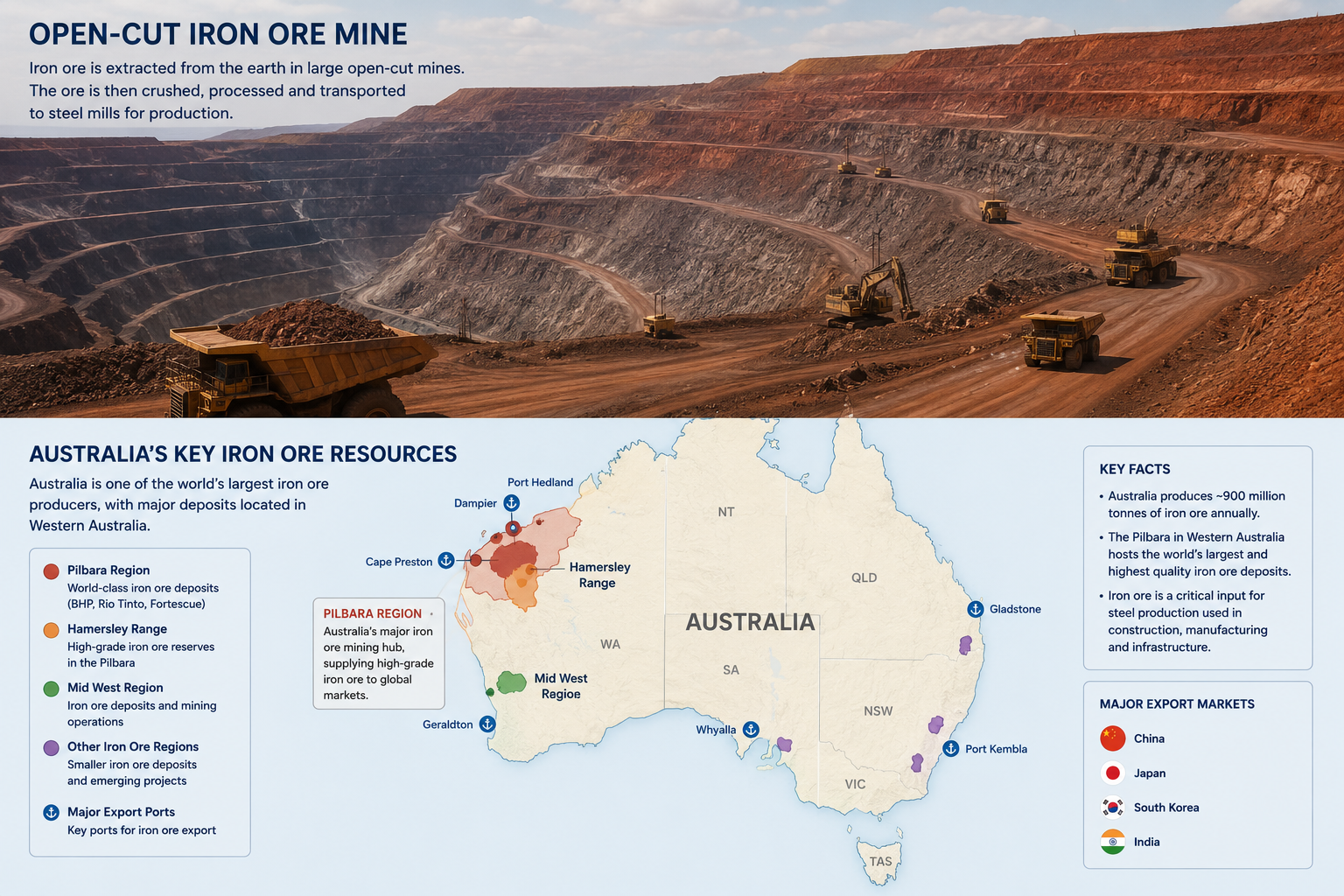
Australia is one of the world's leading producers of iron ore and plays a critical role in the global steel industry.
Large iron ore deposits are concentrated within the Pilbara region of Western Australia, where mining companies extract hundreds of millions of tonnes of ore every year. This resource underpins both Australia's domestic steel production and a significant proportion of the world's steel manufacturing.
Major Australian producers include:
|
Company |
Primary Operations |
|---|---|
|
BHP |
Pilbara Iron Ore |
|
Rio Tinto |
Pilbara Iron Ore |
|
Fortescue |
Pilbara Iron Ore |
|
Mineral Resources |
Iron Ore & Mining Services |
Iron ore is transported by dedicated heavy-haul rail networks to export terminals and domestic steel manufacturers, beginning its transformation into one of the world's most versatile construction materials.
From Rock to Steel
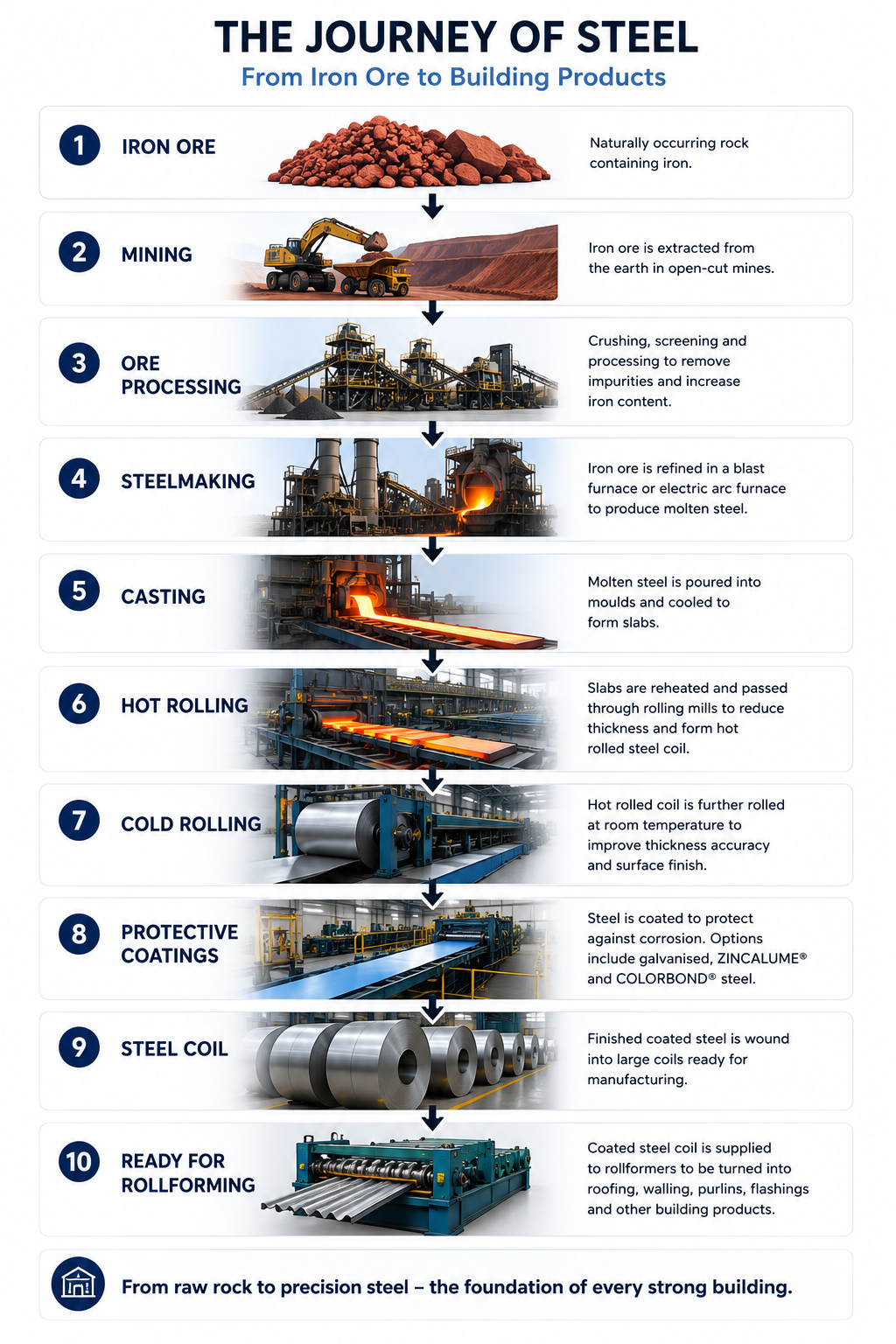
Although the process involves sophisticated engineering and metallurgy, the journey can be understood in eight key stages.
Step 1 — Mining
Iron ore is extracted from large open-cut mines using heavy earthmoving equipment.
Typical mining equipment includes:
-
Hydraulic excavators
-
Electric rope shovels
-
Blast hole drills
-
Haul trucks
-
Crushers
-
Conveyors
After blasting, the ore is crushed and transported for further processing.
Step 2 — Ore Processing
Before iron ore can be used to manufacture steel, it must be processed.
Processing generally involves:
-
Crushing
-
Screening
-
Washing
-
Beneficiation (where required)
These processes remove impurities and produce a consistent feedstock suitable for steelmaking.
The finished product is typically transported by rail to port facilities or steelworks.
Step 3 — Steelmaking
Iron ore itself is not steel.
Steel is produced by removing oxygen from iron ore and carefully controlling the amount of carbon and alloying elements.
Traditionally this occurs within:
-
Blast Furnaces
-
Basic Oxygen Furnaces (BOF)
Increasingly, electric arc furnaces (EAF) are also used, particularly where recycled steel is available.
Steelmakers continually adjust chemistry to produce steels with different properties including:
-
strength
-
ductility
-
corrosion resistance
-
weldability
-
formability
Step 4 — Casting
Molten steel is cast into semi-finished products known as:
-
Slabs
-
Blooms
-
Billets
Each serves a different downstream purpose.
For the shed industry, slabs are particularly important because they become flat steel products.
Step 5 — Rolling
The cast steel is reheated and passed through rolling mills.
Rolling reduces thickness while improving mechanical properties.
The result becomes:
-
Hot Rolled Coil (HRC)
-
Plate
-
Structural Sections
Hot rolled coil forms the starting point for many products used throughout the shed industry.
Step 6 — Cold Rolling
Hot rolled coil is further processed into Cold Rolled Coil (CRC).
Cold rolling produces:
-
smoother surfaces
-
tighter tolerances
-
improved dimensional accuracy
These characteristics make cold rolled steel suitable for coating and rollforming.
Step 7 — Protective Coatings
Steel naturally corrodes when exposed to moisture and oxygen.
To improve durability, steel is coated before reaching manufacturers.
Common products include:
Galvanised Steel
A zinc coating protects the underlying steel by sacrificial corrosion.
Used extensively in structural and general construction applications.
ZINCALUME® Steel
BlueScope developed ZINCALUME® using an aluminium-zinc alloy coating.
Benefits include:
-
excellent corrosion resistance
-
long service life
-
ideal substrate for roofing and walling
COLORBOND® Steel
COLORBOND® begins as ZINCALUME® steel before multiple paint layers are applied.
These layers provide:
-
colour
-
UV protection
-
improved durability
-
architectural appearance
Most Australian residential sheds use COLORBOND® roofing and walling.
Step 8 — Coil Production
After coating, steel is wound into enormous coils.
These coils often weigh several tonnes.
This is the product purchased by companies such as:
-
Lysaght
-
Metroll
-
Stratco
-
Steeline
-
Fielders
The coil itself is still flat.
Its final shape has not yet been created.
(Insert photograph or illustration of a steel coil.)
Step 9 — Rollforming
Rollforming transforms flat coil into finished building products.
Progressive rollers gradually bend the steel into profiles such as:
-
Trimdek
-
Corrugated
-
Spandek
-
Purlins
-
Girts
-
Flashings
-
Gutters
This process will be explored in the next chapter.
Why Steel?
Steel has become the preferred material for Australian shed construction because it offers an excellent combination of strength, durability and efficiency.
Compared with alternative materials, steel provides several important advantages:
|
Advantage |
Benefit |
|---|---|
|
High strength-to-weight ratio |
Allows large clear spans with relatively lightweight members |
|
Dimensional consistency |
Manufactured to precise tolerances, improving fit and reducing site adjustments |
|
Speed of construction |
Prefabricated components can be assembled quickly on site |
|
Design flexibility |
Easily adapted to a wide range of building sizes and roof configurations |
|
Durability |
Long service life when protected with appropriate coatings |
|
Recyclability |
Steel is one of the world's most recycled construction materials |
|
Low maintenance |
Coated products such as COLORBOND® and ZINCALUME® require minimal ongoing maintenance |
These characteristics have made cold-formed steel the dominant construction material for Australian sheds, garages, workshops and many light industrial buildings
Looking Ahead
At this stage the steel has not yet become a shed component.
It remains as flat coated steel wound into large coils.
The next chapter explores how these coils are transformed through rollforming into roof sheeting, wall cladding, purlins, girts, flashings and structural members—the building blocks of every modern steel shed
Chapter Summary
Every steel building begins long before the design process. Its journey starts with iron ore mined from the earth, which is transformed through a series of sophisticated manufacturing processes into high-quality steel coil.
These processes—including steelmaking, rolling and protective coating—determine the strength, durability and corrosion resistance of the finished material. By the time the steel reaches Australian rollformers, it has become a precisely engineered product ready to be manufactured into roofing, walling and structural components.
Understanding this journey provides an appreciation of the technology, quality control and manufacturing expertise behind every steel building. It also lays the foundation for the next stage of the supply chain, where flat steel coil is transformed into the building products used throughout the Australian shed industry.
Learning Objectives
By the end of this chapter, you should be able to:
-
Explain how iron ore is transformed into steel suitable for the construction industry.
-
Describe the major stages of steel production, from mining through to coated steel coil.
-
Differentiate between hot rolled steel, cold rolled steel and coated steel products.
-
Understand the purpose of protective coatings such as galvanising, ZINCALUME® and COLORBOND®.
-
Recognise why steel is the preferred material for modern shed construction.
-
Explain why steel supplied to rollformers remains flat until it is manufactured into finished building products.