
From Steel Coil to Building Products
Introduction
In the previous chapter, we followed the journey of steel from iron ore through mining, steelmaking and protective coating until it became a finished steel coil.
At this point, the steel has been manufactured—but it is still simply a flat roll of coated steel.
Before it can become part of a building, that coil must be transformed into roofing, wall cladding, purlins, flashings and structural components.
This chapter explores the companies responsible for that transformation and explains how Australia's steel supply chain supports the shed industry.
Australia's Steel Supply Chain
Australia has a large mining industry and is one of the world's leading producers of iron ore. However, the domestic steel supply chain for the shed industry is far more concentrated than many people realise.
For steel sheds, the most important products are not heavy structural beams used in bridges or high-rise buildings. Instead, the industry relies on high-quality flat steel products that can be formed into roofing, wall cladding and cold-formed structural sections.
The primary products used throughout the Australian shed industry include:
-
Hot Rolled Coil (HRC)
-
Cold Rolled Coil (CRC)
-
Galvanised Steel
-
ZINCALUME® Steel
-
COLORBOND® Steel
These products form the foundation of almost every modern steel shed.
BlueScope Steel
BlueScope is Australia's leading manufacturer of coated flat steel products and is the principal supplier of steel used throughout the Australian shed industry.
BlueScope manufactures:
-
Hot Rolled Coil
-
Cold Rolled Coil
-
Galvanised Steel
-
ZINCALUME® Steel
-
COLORBOND® Steel
These products are supplied as large steel coils to downstream manufacturers who convert them into finished building products.
Unlike rollformers, BlueScope generally produces the raw steel product—not the finished roofing, walling or structural components.
Key Resources
Understanding Steel Coatings
Not all steel used in shed construction is the same.
Protective coatings significantly improve corrosion resistance and determine how the finished building performs over decades of exposure to Australia's climate.
Galvanised Steel
Galvanised steel is coated with zinc to provide corrosion protection.
Common applications include:
-
Brackets
-
Fasteners
-
Structural components
-
General fabrication
ZINCALUME® Steel
ZINCALUME® steel is protected by an aluminium-zinc alloy coating that provides excellent durability and corrosion resistance.
Typical applications include:
-
Roof sheeting
-
Wall cladding
-
Garage doors
-
Structural sections
-
Flashings
It also serves as the base material for COLORBOND® steel.
COLORBOND® Steel
COLORBOND® steel begins as ZINCALUME® steel before multiple paint layers are applied.
Its combination of durability, corrosion resistance and architectural colour has made it Australia's most recognised steel building product.
Typical applications include:
-
Roof sheeting
-
Wall cladding
-
Gutters
-
Flashings
-
Fascia
-
Doors
-
Architectural features
For many customers, the colour of the shed is one of the first purchasing decisions they make. While customers often recognise COLORBOND® by name, they may not appreciate that it is only one part of a much larger engineered building system.
Rollformers & Building Product Manufacturers
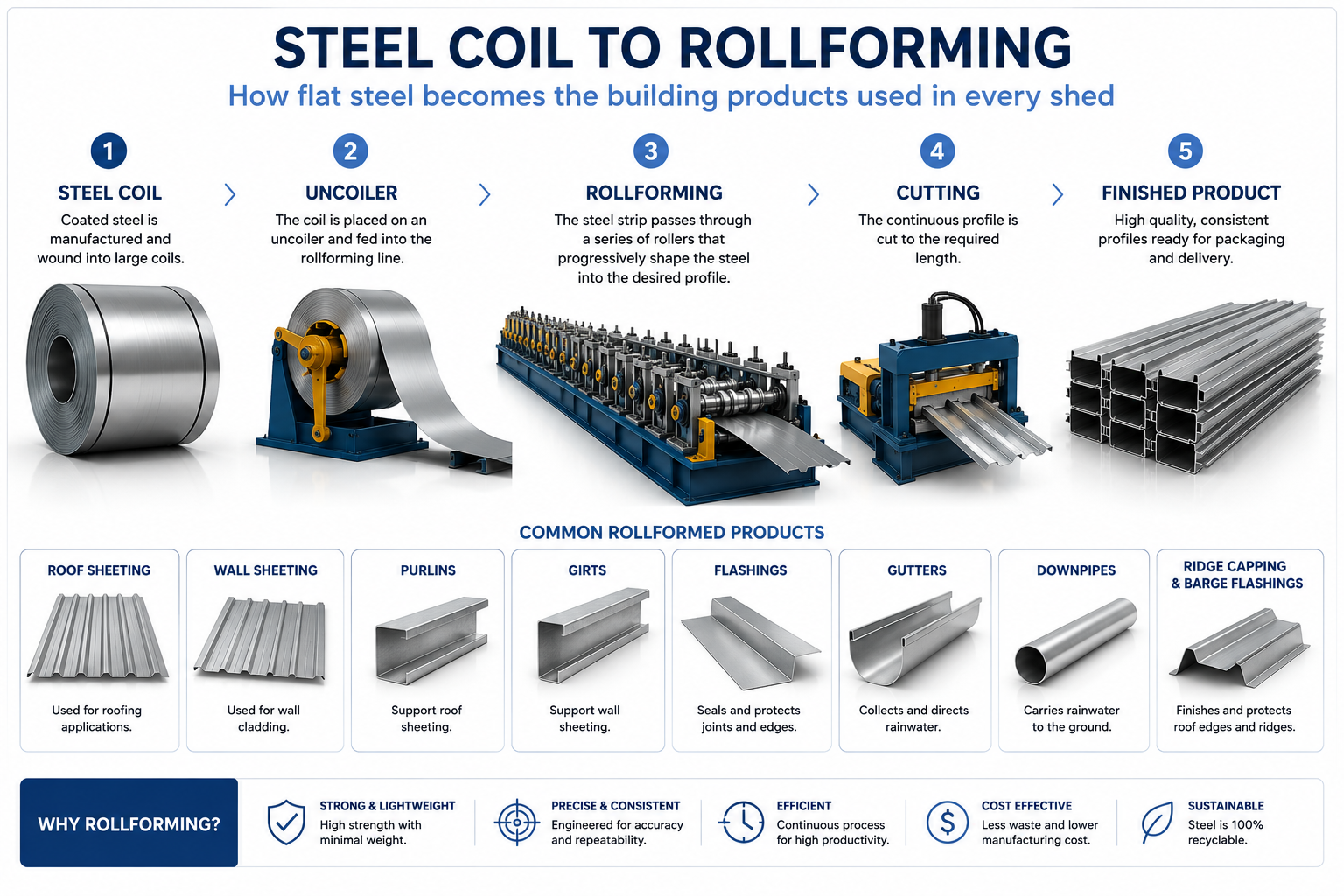
Once steel coil leaves BlueScope, it is supplied to specialist manufacturers known as rollformers.
Rollforming is a continuous manufacturing process where flat steel coil passes through a series of rollers that gradually bend the steel into a finished profile.
This process produces many of the products used throughout the shed industry.
Common rollformed products include:
-
Roof sheeting
-
Wall sheeting
-
Purlins
-
Girts
-
Flashings
-
Gutters
-
Downpipes
-
Ridge capping
-
Barge flashings
-
Structural channels
Major Australian Rollformers
Australia has several well-established building product manufacturers supplying the steel shed industry.
|
Company |
Primary Products |
|---|---|
|
Lysaght |
Roofing, walling, purlins, structural sections and rainwater products |
|
Metroll |
Roofing, walling, flashings, rainwater goods, purlins and structural members |
|
Stratco |
Roofing, walling, sheds, patios, rainwater systems and building products |
|
Steeline |
National network manufacturing roofing, walling and structural steel products |
|
Fielders |
Roofing, walling, architectural cladding and rainwater products |
Did you know?
Lysaght is a BlueScope business and manufactures many of its products using BlueScope-produced COLORBOND® and ZINCALUME® steel.
Metroll, Stratco, Steeline and Fielders are independent manufacturers that also utilise high-quality coated steel products to produce their own building systems.
Why Supplier Differences Matter
Although many suppliers manufacture similar products, their product ranges are not identical.
Differences may include:
-
Roof profiles
-
Wall profiles
-
Purlin systems
-
Girt systems
-
Structural capacities
-
Maximum available lengths
-
Standard colours
-
Product codes
-
Manufacturing tolerances
-
Lead times
-
Branch locations
-
Freight rules
-
Delivery areas
-
Minimum order values
-
Fuel surcharges
-
Order confirmation formats
For this reason, Quotec cannot simply substitute one supplier for another.
A building engineered around one supplier's product range may require design, procurement or engineering changes before it can be ordered from a different manufacturer.
Supplier selection is therefore a critical part of the overall building workflow.
Specialist Component Manufacturers
A complete shed requires much more than structural steel.
While the portal frames, purlins, girts, roof sheets and wall sheets form the main structure, a finished building also requires a range of specialist components. These components are often manufactured by separate suppliers with their own product ranges, lead times, order requirements and freight arrangements.
This is why a shed supply package is rarely a single-manufacturer product. It is usually a coordinated package made up of multiple specialised product groups.
Common Specialist Suppliers
|
Component |
Typical Supplier / Manufacturer |
Role in the Building |
|---|---|---|
|
Roller Doors |
Gliderol, Steel-Line, B&D |
Provide vehicle access and are often one of the most visible customer-facing components. |
|
Windows |
Advance Metal Industries Australia (AMIA) |
Provide natural light, ventilation and amenity. |
|
Personal Access Doors |
AMIA and other door suppliers |
Provide pedestrian access separate from roller doors. |
|
Fasteners |
The Building Connection, CDA, Allfix |
Supply screws, bolts, rivets, anchors and fixings required to assemble the structure. |
|
Slab Brackets / Q-Plates® |
Stoddart Manufacturing, Dowling Metal Products |
Provide engineered connection systems between the steel structure and concrete slab. |
|
Guttering & Accessories |
Rollformers and fabricated steel suppliers |
Manage rainwater and finish exposed roof edges. |
|
Flashings |
Rollformers and sheet metal suppliers |
Seal junctions, corners, roof edges and wall openings. |
|
Insulation |
Kingspan, Bradford, Fletcher Insulation |
Improve thermal performance, condensation control and internal comfort. |
|
Skylights |
Polycarbonate manufacturers |
Provide natural light through roof or wall cladding. |
|
Vents, Louvres & Accessories |
Specialist ventilation and building accessory suppliers |
Support airflow, ventilation and specific customer requirements. |
Why Specialist Components Matter
Specialist components often appear small compared with the main steel structure, but they can have a major impact on the success of the project.
For example:
-
A missing box of fasteners can prevent construction from starting.
-
An incorrect roller door size can affect both the building opening and the customer’s use of the shed.
-
Incorrect brackets or slab connections can create engineering and compliance issues.
-
Windows and PA doors often have separate manufacturing lead times and may be delivered independently.
-
Insulation may require coordination with the cladding installation sequence.
-
Skylights and roof accessories can affect roof sheeting layout and weatherproofing.
These items are not afterthoughts. They are part of the complete building package.
One Shed — Many Manufacturers
Although a customer may purchase one shed, the finished building is usually the result of many manufacturers contributing different products.
A typical Quotec project may include:
|
Product Group |
Example Supplier |
|---|---|
|
Base steel coil |
BlueScope |
|
Roof sheeting and wall cladding |
Metroll, Lysaght, Stramit, Steeline, Fielders |
|
Purlins and girts |
Metroll, Lysaght, Stramit, Steeline, Fielders |
|
Roller doors |
Gliderol, Steel-Line, BnD |
|
Windows and PA doors |
AMIA, GJames Glass |
|
Fasteners |
The Building Connection, CDA, Allfix |
|
Slab brackets / Q-Plates® |
Stoddart Manufacturing, Dowling Metal Products |
|
Insulation |
Kingspan, Bradford, Fletcher Insulation |
|
Skylights |
Polycarbonate product supplier (procured through steel supplier) |
To the customer, this is one building.
Operationally, it may be five, six or more supplier orders that need to be coordinated correctly.
Key Takeaway
A complete steel shed is not manufactured by one company. It is assembled from products supplied by many specialist manufacturers. The success of the project depends on how accurately those products are specified, ordered, confirmed, delivered and installed.
Supplier Coordination
Each specialist supplier may have different requirements, including:
-
product codes
-
order formats
-
colour options
-
size limitations
-
manufacturing lead times
-
freight arrangements
-
delivery regions
-
dispatch dates
-
minimum order values
-
surcharges
-
confirmation documents
This is why procurement is such an important part of the shed industry.
The design and engineering may be correct, but the project can still fail if the wrong specialist component is ordered, manufactured late, delivered to the wrong location or omitted from the supply package.
How Quotec Supports This Process
Quotec helps bring these separate product groups into one coordinated workflow.
Rather than treating the shed as a single generic product, Quotec breaks the building down into the components required for supply and delivery.
This allows shed businesses to:
-
generate supplier-specific Bills of Materials
-
prepare purchase orders
-
allocate products to the correct suppliers
-
manage pricing and supplier rules
-
coordinate staged deliveries
-
check supplier confirmations
-
reduce manual ordering errors
-
provide clearer visibility from design through to delivery
This coordinated approach allows businesses to use specialised suppliers while still presenting the customer with a complete, professional building package.
Looking Ahead
At this point in the supply chain, the individual building products have been manufactured.
The next chapter brings these components together for the first time by exploring the anatomy of a steel building. You will learn how roof sheeting, purlins, portal frames, flashings and accessories work together to create a complete engineered structure.
Chapter Summary
Steel manufacturers produce the high-quality coated steel that underpins Australia's shed industry, while rollformers and specialist manufacturers transform that steel into the roofing, walling, structural members and accessories required to construct a complete building.
Although customers see a single finished shed, it is actually a carefully coordinated assembly of products manufactured by multiple specialist suppliers. Understanding the roles of these suppliers—and the differences between their products—is essential for accurate engineering, procurement and successful project delivery.
Learning Objectives
By the end of this chapter, you should be able to:
-
Explain the difference between a steel manufacturer and a building product manufacturer.
-
Identify the major suppliers of steel products used in the Australian shed industry.
-
Understand the role of rollforming in manufacturing building products.
-
Describe the purpose of COLORBOND®, ZINCALUME® and galvanised steel.
-
Recognise why supplier selection influences engineering, procurement and logistics.
-
Understand why a complete shed consists of products supplied by multiple specialist manufacturers.