
What is Procurement?
Procurement is the process of converting an engineered building design into supplier-ready purchase orders.
Once engineering has determined what needs to be supplied, procurement determines:
-
Who supplies it
-
What is ordered
-
Where it is delivered
-
When it is required
-
How it will arrive on site
Unlike many construction products, a steel shed is rarely supplied by a single manufacturer. A complete building package typically consists of products manufactured by several independent suppliers, all of which must arrive at the correct location, in the correct sequence, and within the required construction timeframe.
Procurement therefore sits at the intersection of engineering, purchasing, manufacturing, logistics and customer service.
Procurement Workflow
The procurement lifecycle typically follows the process below.
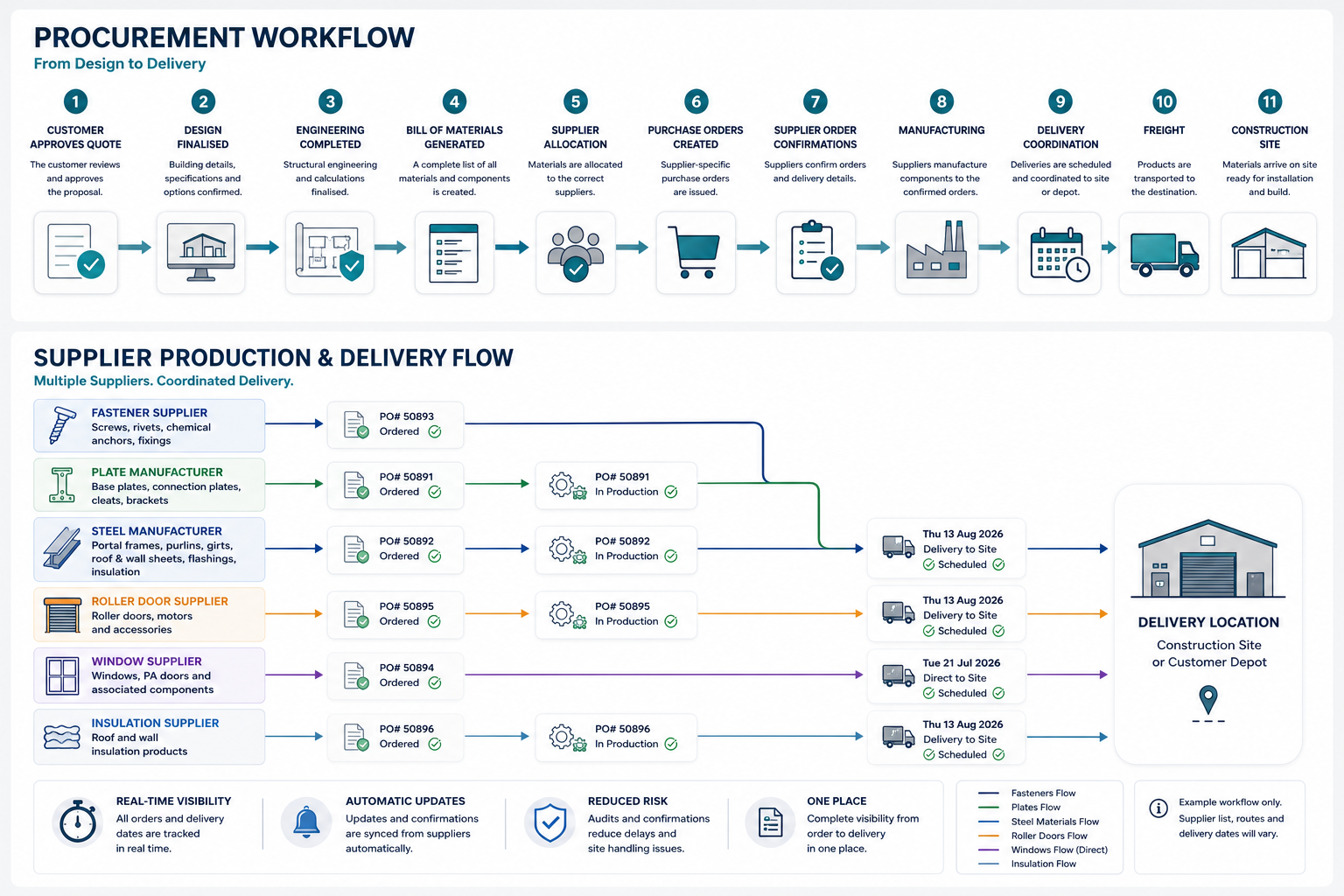
Each stage depends on the successful completion of the previous stage.
The Bill of Materials (BOM)
The Bill of Materials is often misunderstood.
A BOM is not a purchase order.
It is a comprehensive list of every component required to construct the building.
A BOM typically includes:
-
Structural members
-
Roof sheeting
-
Wall sheeting
-
Flashings
-
Purlins
-
Girts
-
Roller doors
-
Personal access doors
-
Windows
-
Skylights
-
Fasteners
-
Brackets
-
Hold-down components
-
Insulation
-
Rainwater goods
Think of the BOM as the shopping list.
Procurement is the process of purchasing everything on that shopping list from the correct suppliers.
Procurement Outputs
Once the BOM has been generated, procurement produces a number of commercial and manufacturing documents.
Typical outputs include:
|
Procurement Output |
Purpose |
|---|---|
|
Purchase Orders |
Instruct suppliers to manufacture and supply products |
|
Supplier-specific BOMs |
Filter materials relevant to each supplier |
|
Product Codes |
Match supplier catalogues and inventory |
|
Colours |
Ensure correct COLORBOND®, ZINCALUME® or finish selection |
|
Length Schedules |
Required for manufactured steel products |
|
Quantities |
Manufacturing and pricing accuracy |
|
Delivery Instructions |
Freight and unloading requirements |
|
Delivery Address |
Site or depot destination |
|
Site Contact Details |
Delivery coordination |
|
Required Delivery Dates |
Construction scheduling |
|
Special Instructions |
Notes relating to access, consolidation or sequencing |
One Shed — Multiple Suppliers
Unlike purchasing a single manufactured product, a steel shed is assembled from many independently manufactured components.
A typical procurement package may resemble the following:
|
Supplier |
Typical Products |
|---|---|
|
Steel Supplier |
Portal frames, purlins, girts, roof & wall sheeting, flashings |
|
Roller Door Supplier |
Roller doors, motors, accessories |
|
Window Supplier |
Aluminium windows and PA doors |
|
Fastener Supplier |
Screws, rivets, chemical anchors, brackets |
|
Plate Manufacturer |
Base plates, connection plates |
|
Insulation Supplier |
Roof and wall insulation |
|
Accessories |
Skylights, vents, flashings and specialty items |
Each supplier has its own:
-
manufacturing process
-
order acknowledgement
-
production schedule
-
freight arrangements
-
delivery requirements
Procurement is therefore an exercise in coordination rather than simply purchasing.
Procurement Risks
Every purchase order introduces risk.
Even small mistakes can create significant downstream consequences.
|
Procurement Risk |
Potential Consequence |
|---|---|
|
Incorrect member length |
Material unusable on site |
|
Incorrect colour |
Replacement manufacturing required |
|
Incorrect quantity |
Construction delays |
|
Wrong supplier branch |
Manufacturing delay |
|
Incorrect delivery address |
Failed freight delivery |
|
Incorrect engineering revision |
Non-compliant structure |
|
Outdated pricing |
Reduced project margin |
|
Missed supplier surcharge |
Underquoted project |
|
Missing accessories |
Builder unable to complete installation |
|
Manual data entry error |
Costly rework |
Unlike many industries, steel components are frequently manufactured specifically for one project.
Once manufactured they often cannot be returned or resold.
Accuracy is therefore critical.
Supplier Purchase Orders
A purchase order is the formal instruction authorising a supplier to manufacture and deliver products.
A purchase order typically includes:
-
Customer reference
-
Quotec Job Number
-
Purchase Order Number
-
Delivery Address
-
Delivery Contact
-
Required Delivery Date
-
Product Descriptions
-
Lengths
-
Colours
-
Quantities
-
Commercial Totals
-
Freight Instructions
-
Special Manufacturing Notes
Once accepted, the purchase order becomes the basis for manufacturing.
Supplier Confirmations
Most suppliers will acknowledge receipt of a purchase order by issuing an Order Confirmation (also referred to as an Order Acknowledgement).
This document confirms the supplier's interpretation of the purchase order before manufacturing begins.
It represents the final opportunity to identify discrepancies before products enter production.
Supplier confirmations should never be treated as administrative paperwork.
They are one of the most important quality assurance checkpoints in the supply chain.
Quotec Supplier Confirmation Audit
Quotec performs supplier confirmation audits to verify that supplier acknowledgements accurately reflect the original purchase order.
Typical audit checks include:
|
Audit Item |
Purpose |
|---|---|
|
Supplier |
Correct manufacturer |
|
Purchase Order Number |
Correct order referenced |
|
Job Number |
Matches customer project |
|
Customer Name |
Correct project allocation |
|
Delivery Address |
Correct destination |
|
Delivery Contact |
Site coordination |
|
Dispatch Date |
Construction planning |
|
Product Descriptions |
Correct materials |
|
Colours |
Manufacturing accuracy |
|
Lengths |
Manufacturing accuracy |
|
Quantities |
Complete supply |
|
Freight Charges |
Commercial accuracy |
|
Fuel Surcharges |
Supplier pricing validation |
|
GST |
Commercial validation |
|
Final Total |
Purchase order reconciliation |
Only after these checks have been completed should manufacturing proceed.
This process significantly reduces the likelihood of site issues resulting from supplier interpretation errors.
Manufacturing
Once supplier confirmations have been accepted, manufacturing begins.
Unlike stocked building products, many steel components are manufactured specifically for each project.
Examples include:
-
Custom-length roof sheets
-
Flashings
-
Portal frames
-
Purlins
-
Girts
-
Connection plates
Manufacturing lead times vary by supplier and product type.
A complete building package may therefore be in production at several different factories simultaneously.
Coordinated Deliveries
Not every supplier delivers directly to the construction site.
Many projects require staged deliveries or consolidation.
For example:
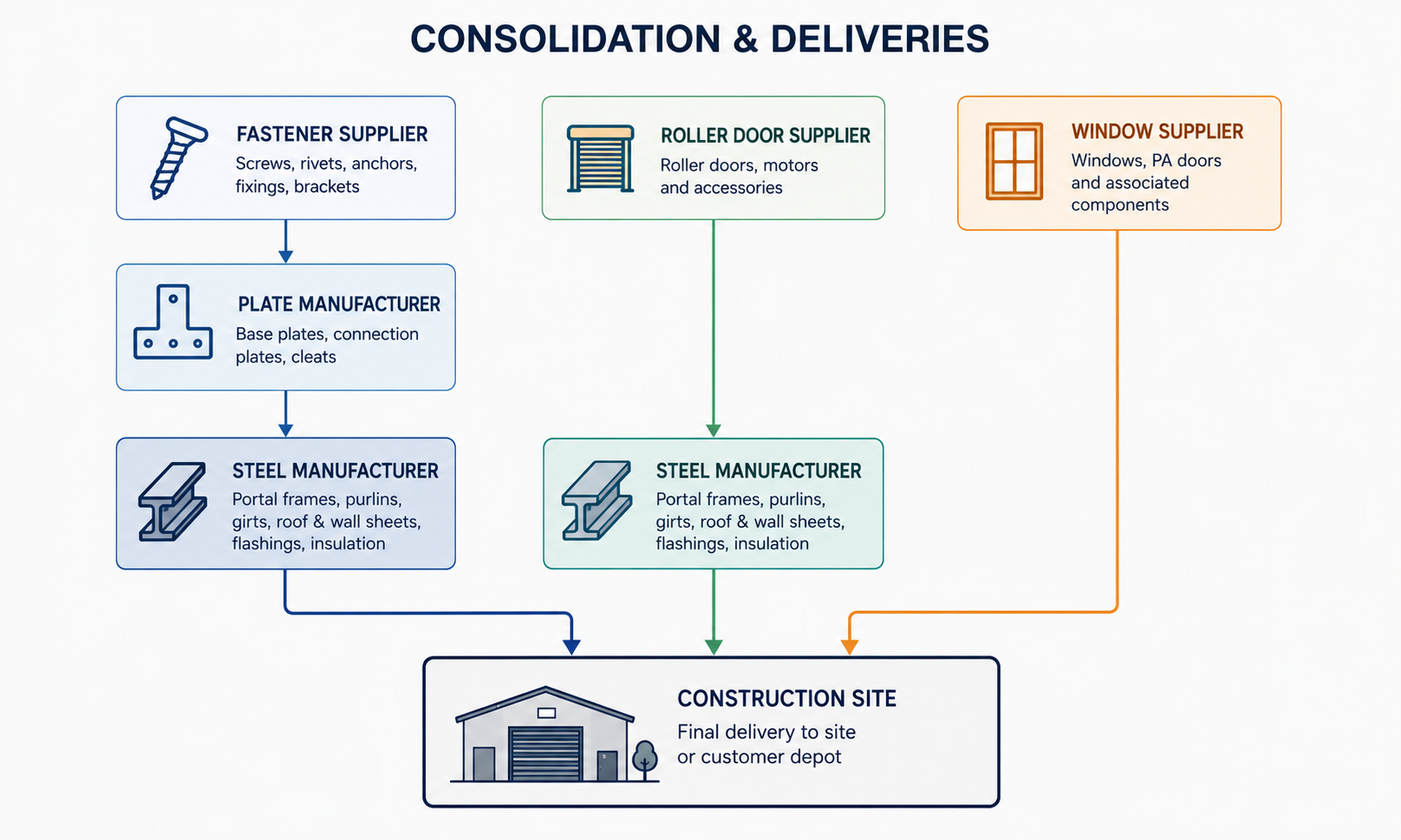
This coordination ensures that products arrive in the correct sequence while minimising freight costs and reducing handling on site.
Logistics and Freight
Steel shed logistics present unique challenges.
Products are frequently:
-
Long (up to 12 metres or more)
-
Heavy
-
Custom manufactured
-
Difficult to replace
-
Expensive to transport
-
Sensitive to handling damage
Successful freight planning considers:
-
Vehicle access
-
Delivery timing
-
Crane or forklift availability
-
Rural freight limitations
-
Multiple supplier coordination
-
Consolidated deliveries
-
Site unloading capability
Unlike consumer goods, steel building components are often impossible to leave unattended or redeliver economically.
Freight therefore forms an integral part of the overall customer experience.
Construction
The builder receives the completed procurement package.
Successful construction depends on receiving:
-
Correct engineering drawings
-
Complete material supply
-
Correct member lengths
-
Correct colours
-
Correct fasteners
-
Correct brackets
-
Correct delivery sequencing
Errors originating during procurement frequently become construction problems.
For this reason, procurement quality directly influences customer satisfaction.
Why Quotec's Procurement Workflow Matters
Many software platforms finish once the building has been designed.
Quotec continues beyond design by supporting the commercial and operational processes required to successfully deliver a complete building package.
Quotec assists businesses by:
-
Generating supplier-specific Bills of Materials
-
Producing supplier purchase orders
-
Coordinating multiple suppliers
-
Tracking supplier confirmations
-
Validating supplier acknowledgements
-
Supporting freight coordination
-
Reducing manual administration
-
Improving procurement accuracy
-
Providing complete visibility from design through to delivery
Rather than treating procurement as an administrative task, Quotec integrates it into the overall building lifecycle, helping businesses move efficiently from customer approval to successful site delivery.
Chapter Summary
Design determines what is required. Engineering determines how it must be built. Procurement determines who supplies each component and how those components reach the customer.
A successful shed project is not measured solely by good engineering or an accurate quote—it is measured by a complete, coordinated delivery arriving on site ready for construction. Quotec bridges this gap by connecting design, engineering, procurement, supplier management and logistics into a single workflow, reducing risk and giving customers confidence that what was designed is exactly what will be delivered.
Learning Objectives
By the end of this chapter you should understand:
-
What procurement means within the Australian shed industry.
-
Why a Bill of Materials (BOM) is only the beginning of the purchasing process.
-
How one shed becomes multiple supplier orders.
-
The risks associated with manual procurement.
-
Why supplier confirmations are critical.
-
How Quotec coordinates procurement across multiple suppliers.
-
Why logistics planning is essential to a successful project.