
How Technology Connects Design, Engineering, Procurement and Delivery
Introduction
A modern steel shed business does far more than sell steel buildings.
While customers often see a simple quote for a shed, the business behind that quote coordinates a complex series of technical, commercial and logistical activities involving multiple suppliers, engineers, manufacturers and contractors.
Every successful project requires careful management from the initial customer enquiry through to final delivery and after-sales support.
This chapter explores how modern shed businesses operate and the critical role software platforms play in connecting every stage of the project lifecycle.
The Modern Shed Business
Unlike traditional manufacturers, most shed businesses do not manufacture every component themselves.
Instead, they act as project coordinators, bringing together engineering, suppliers, manufacturers and logistics into a single customer solution.
The customer purchases one shed.
Behind the scenes, the shed business may coordinate six or more suppliers, multiple freight providers, engineering certification, procurement, manufacturing and delivery schedules.
Their role is to simplify this complexity for the customer.
Typical Quotec Customers
Quotec is used by a broad range of businesses throughout Australia.
Typical users include:
-
Independent shed retailers
-
Rural merchandise suppliers
-
Steel building suppliers
-
Agricultural building specialists
-
Builders supplying kit sheds
-
Construction companies expanding into shed sales
-
Regional building suppliers
-
Steel fabrication businesses
-
Home improvement companies
-
Trade businesses diversifying into steel buildings
Although these businesses vary considerably in size, they all perform the same fundamental role—designing, pricing, selling and coordinating steel building projects.
The Role of a Shed Business
Every project typically involves responsibility for:
Sales
-
Customer enquiries
-
Discovery meetings
-
Site discussions
-
Budget guidance
Design
-
Building dimensions
-
Roof style
-
Openings
-
Colours
-
Accessories
-
Customer revisions
Engineering
-
Site-specific wind calculations
-
Structural member selection
-
Engineering certification
-
Design changes
Procurement
-
Bills of Materials
-
Purchase Orders
-
Supplier allocation
-
Pricing validation
Supplier Coordination
-
Manufacturing schedules
-
Order confirmations
-
Delivery sequencing
-
Variations
Customer Service
-
Construction documentation
-
Delivery updates
-
Warranty support
-
After-sales service
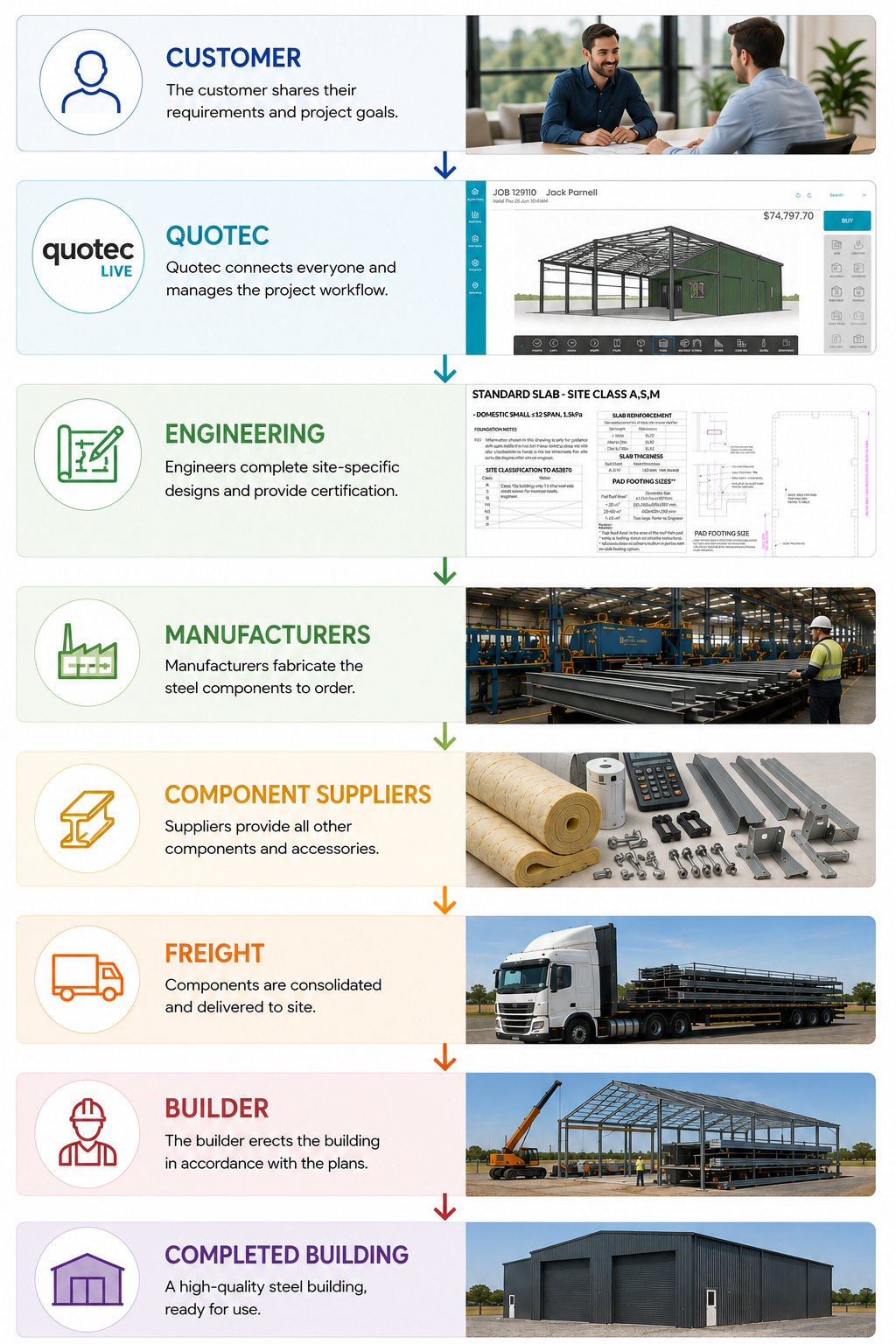
The Complete Project Lifecycle
Every stage depends on the successful completion of the previous stage.
Errors introduced early in the process become increasingly expensive to correct later.
Why Software Became Essential
Twenty years ago many shed businesses operated using:
-
Hand sketches
-
Spreadsheet pricing
-
Paper catalogues
-
Manual engineering
-
Faxed purchase orders
-
Phone calls between suppliers
While this approach could work for simple projects, it became increasingly difficult as buildings became more customised and customer expectations increased.
Modern shed businesses now manage:
-
Hundreds of product combinations
-
Multiple suppliers
-
Site-specific engineering
-
Colour selections
-
Procurement rules
-
Freight coordination
-
Customer documentation
-
Engineering certificates
-
Manufacturing lead times
Managing this manually would be slow, labour-intensive and prone to error.
Specialised software has become essential to maintaining speed, accuracy and profitability.
The Role of Software Platforms
Modern software platforms streamline every stage of the business.
Typical functions include:
Design
-
Building configuration
-
Roof styles
-
Openings
-
Colours
Engineering
-
Wind calculations
-
Structural analysis
-
Member selection
-
Certification workflows
Commercial
-
Pricing
-
Margins
-
Quotations
-
Customer documentation
Procurement
-
Bills of Materials
-
Supplier purchase orders
-
Product allocation
-
Manufacturing documentation
Operations
-
Order tracking
-
Supplier confirmations
-
Delivery scheduling
-
Freight coordination
Where Quotec Fits
Quotec is not simply a quoting program.
It operates as the central workflow platform connecting every stage of the steel shed supply chain.
Quotec integrates:
-
Customer design
-
Site-specific engineering
-
Pricing
-
Bills of Materials
-
Supplier-specific procurement
-
Purchase Orders
-
Supplier confirmation auditing
-
Manufacturing coordination
-
Customer documentation
Rather than replacing manufacturers, engineers or suppliers, Quotec connects them into one efficient digital workflow.
Quotec's Position in the Industry
Quotec acts as the digital operating system sitting at the centre of the project, allowing information to flow accurately between every participant.
Why This Matters
The value of Quotec is not simply faster quoting.
Its real value lies in reducing complexity.
By connecting design, engineering, procurement and supplier coordination into a single platform, Quotec helps businesses:
-
reduce manual data entry
-
minimise ordering errors
-
improve pricing accuracy
-
coordinate multiple suppliers
-
accelerate quote-to-order times
-
provide a consistent customer experience
-
scale operations without proportionally increasing administration
As projects become more complex and customer expectations continue to grow, software has become a fundamental part of operating a modern steel shed business.
Chapter Summary
Modern shed businesses are project coordinators, not simply product suppliers. They manage the entire customer journey, from the first enquiry through engineering, procurement, manufacturing and delivery, while coordinating multiple suppliers and ensuring every component arrives on site ready for construction.
Software platforms have transformed how these businesses operate by replacing manual processes with integrated digital workflows. Quotec sits at the centre of this ecosystem, connecting customers, engineers, suppliers and manufacturers through a single platform that streamlines design, engineering, procurement and delivery. By reducing complexity and improving accuracy, Quotec enables shed businesses to deliver better outcomes for both their customers and supply partners.
Learning Objectives
By the end of this chapter you should be able to:
-
Understand the role of a modern shed retailer.
-
Explain the complete customer journey from enquiry to completion.
-
Identify where engineering, procurement and logistics occur.
-
Understand why specialised software has become essential.
-
Recognise where Quotec fits within the industry.