
From Australian Steel Supply Chain to Retail Customer
Introduction
The Australian steel shed industry is one of the country's largest specialised construction sectors, supplying buildings for residential, rural, commercial and industrial applications.
Every year, thousands of steel structures are designed, engineered, manufactured and erected across Australia. These range from small residential garages through to large warehouses, agricultural buildings, aircraft hangars and industrial facilities.
While the finished product may appear relatively simple, every completed shed is the result of a highly coordinated supply chain involving dozens of specialist businesses, each contributing their expertise at different stages of the project.
Understanding this supply chain is essential to understanding how the industry operates—and ultimately where Quotec fits within it.
More Than Just a Steel Building
A completed shed is far more than a collection of steel components.
Behind every project are organisations responsible for:
-
mining raw materials
-
manufacturing steel
-
producing coated steel products
-
rollforming structural building products
-
manufacturing specialised components
-
engineering and certification
-
procurement and supplier management
-
freight and logistics
-
construction and installation
-
customer support and after-sales service
Each participant depends on the others to deliver a successful project.
A failure at any point in the process—whether engineering, manufacturing, procurement or freight—can affect every stage that follows.
The Australian Shed Industry Ecosystem
Quotec operates within a much larger ecosystem of manufacturers, suppliers, engineers and builders.
Typical participants include:
-
Steel manufacturers
-
Coated steel producers
-
Rollformers
-
Structural steel fabricators
-
Component manufacturers
-
Engineering consultants
-
Building certifiers
-
Shed retailers
-
Procurement teams
-
Freight providers
-
Builders and installers
-
Retail customers
Understanding how these organisations interact provides the foundation for everything covered throughout Quotec Academy.
From Raw Steel to Finished Building
Every shed follows a predictable lifecycle.
It begins with raw materials extracted from the earth and ends with a completed building handed over to its owner.
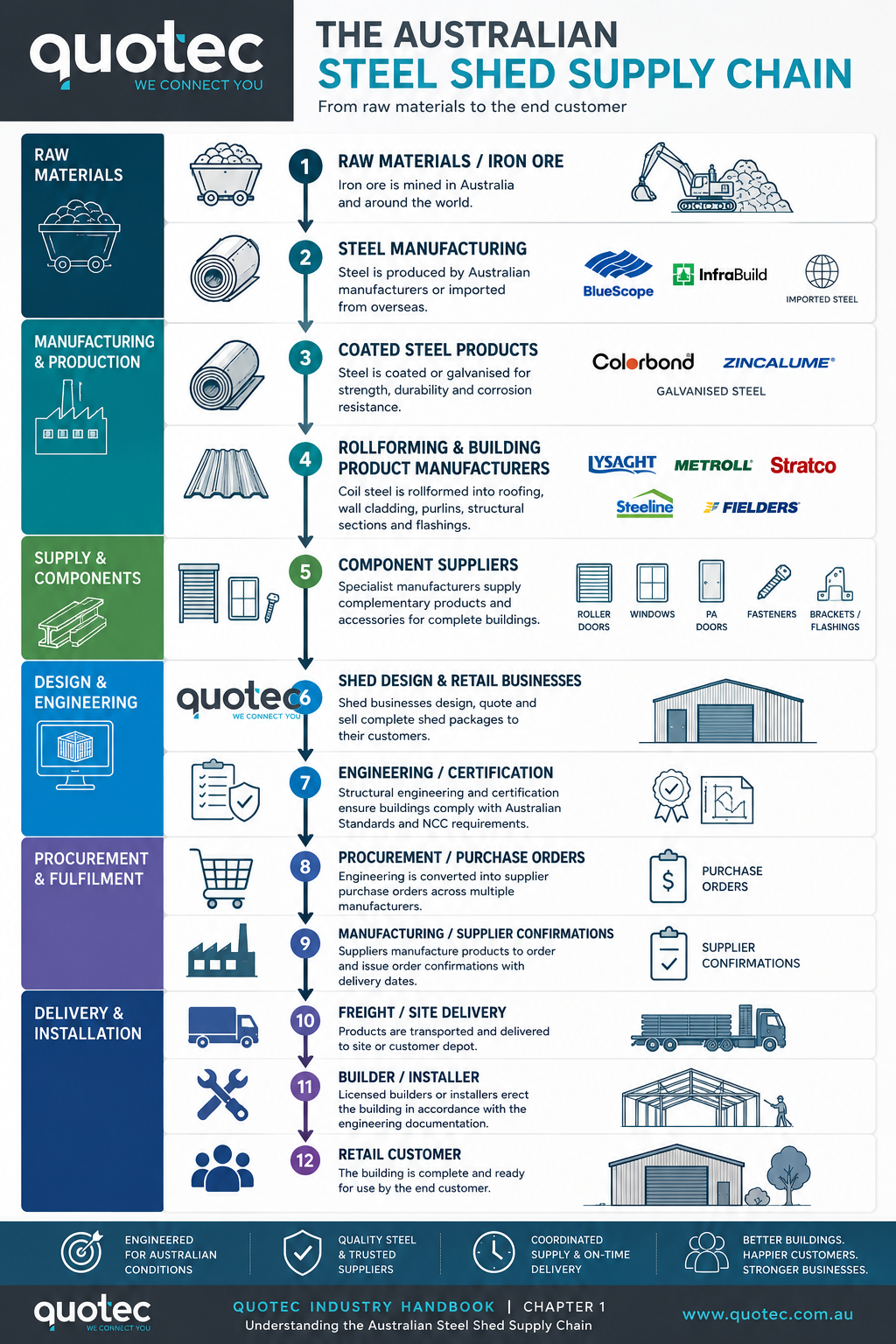
Between these two points lies an interconnected series of design, engineering, procurement, manufacturing and logistics processes that transform raw steel into a finished building package.
The following diagram illustrates this end-to-end supply chain and provides the framework for the chapters that follow.
Why This Matters
Many people entering the industry only experience one part of the process.
For example:
-
A builder focuses on construction.
-
An engineer focuses on structural design.
-
A manufacturer focuses on production.
-
A retailer focuses on selling sheds.
-
A freight company focuses on delivery.
Quotec is different.
Because Quotec connects many parts of the supply chain, our team must understand how each stage influences the next. Design decisions affect engineering. Engineering affects procurement. Procurement drives manufacturing. Manufacturing influences logistics. Logistics determines the customer experience.
Key Takeaway
By understanding the complete lifecycle, our team can better support customers, identify potential issues earlier, and appreciate how seemingly small changes can have significant downstream impacts.
A steel shed is not a single product manufactured by one company. It is the coordinated outcome of an integrated supply chain involving mining, steel production, manufacturing, engineering, procurement, logistics and construction. Understanding this end-to-end process is fundamental to understanding both the Australian shed industry and the role Quotec plays within it.
Chapter Summary
The Australian steel shed industry is a highly connected ecosystem involving steel producers, rollformers, component manufacturers, engineers, certifiers, shed retailers, suppliers, freight providers, builders and end customers.
A finished shed may appear simple, but behind every completed building is a complex sequence of decisions, documents, suppliers, products and logistics. Raw materials are transformed into coated steel, rollformed into building products, engineered into compliant structures, converted into supplier orders, manufactured to project requirements, delivered to site and finally assembled by builders or installers.
For Quotec, understanding this ecosystem is essential. Quotec does not operate as a standalone software product. It sits across the lifecycle of a steel building, helping businesses move from customer enquiry to design, pricing, engineering, procurement and coordinated supply.
The key lesson from this chapter is that a shed is not just a building. It is the outcome of a connected supply chain. The better we understand that chain, the better we can support our customers, improve workflows, reduce risk and deliver stronger outcomes across the industry.
Learning Objectives
By the end of this chapter, you should be able to:
-
Explain the Australian steel shed ecosystem from raw materials through to the retail customer.
-
Identify the major participants in the shed supply chain and the role each one plays.
-
Understand why a steel shed is not a single product, but a coordinated package of engineered components.
-
Recognise how design, engineering, procurement, manufacturing, logistics and construction are connected.
-
Explain why small changes at one stage can create downstream impacts across the entire project.
-
Understand where Quotec fits within the industry ecosystem.
-
Describe how Quotec connects design, pricing, engineering, procurement and delivery workflows.