
Overview
Quotec is a connected business ecosystem for those who run business in the home improvement retail market in Australia.
It helps bring together the people, information and processes involved in moving work through a business.
From the first customer enquiry through to design, pricing, quoting, procurement, production and delivery.
Depending on how your organisation uses Quotec, this can include:
-
customer enquiries and opportunities
-
customer and job information
-
building design
-
pricing and quoting
-
bills of materials
-
engineering and documentation
-
procurement
-
supplier orders
-
production information
-
delivery information
-
operational reporting
Rather than treating each of these as completely separate activities, Quotec is designed to help information move with the job.
For example, information established during design may contribute to pricing and the bill of materials. Information from an accepted quote may then support purchasing, supplier ordering and later operational processes.
This creates a more connected workflow and reduces the need for teams to repeatedly recreate, re-enter or transfer the same information between different stages of a project.
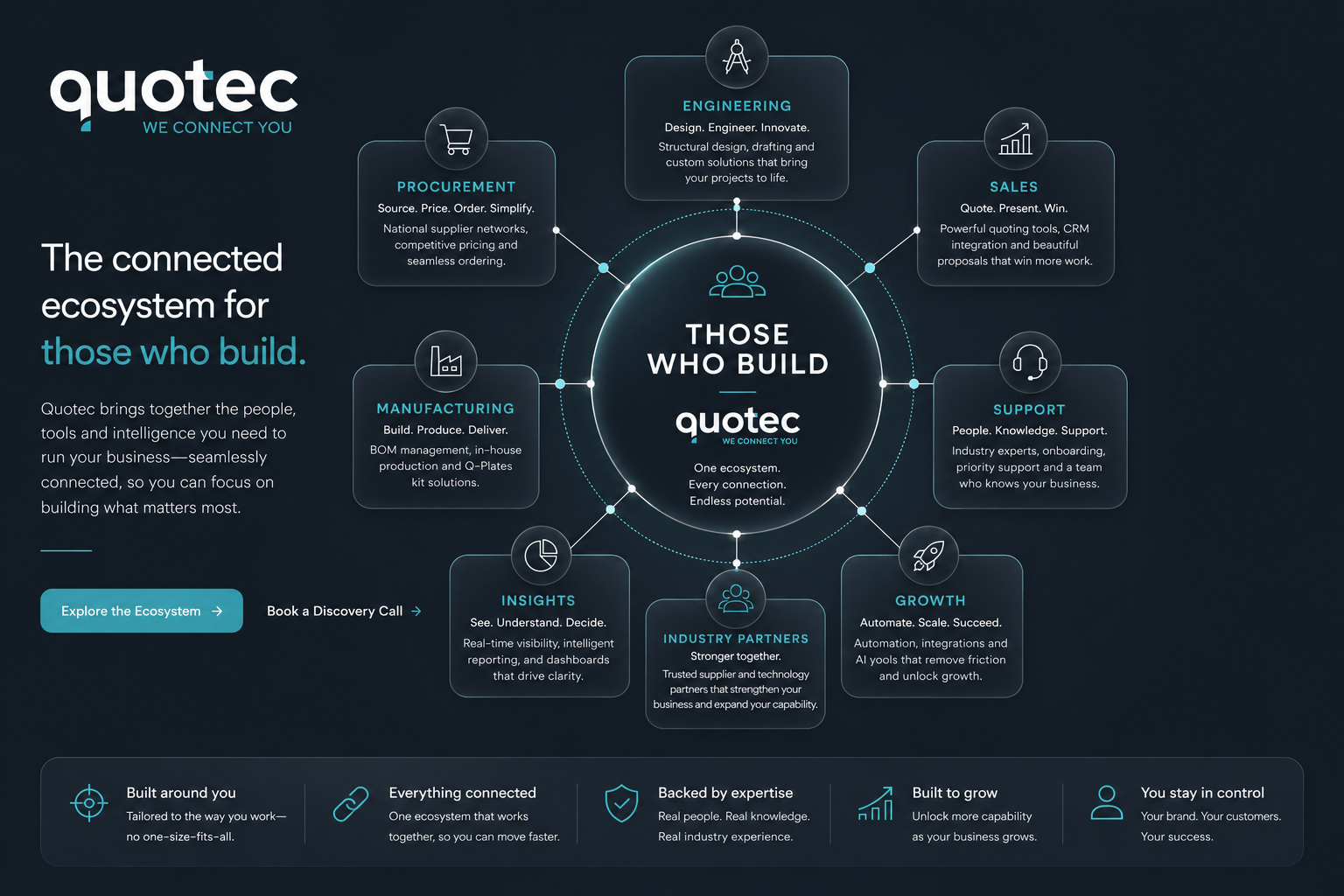
How Quotec supports your business
Every business operates differently.
Some organisations may use Quotec primarily for design and quoting, while others may use it across a much broader operational workflow.
Your organisation's Quotec environment may support areas such as:
|
Area |
What this can involve |
|---|---|
|
Managing customers and jobs |
Keeping customer, project and job information organised so the people working on a project can access the information relevant to them. |
|
Designing buildings |
Creating and configuring building designs while capturing the information required for pricing, materials and downstream processes. |
|
Preparing pricing and quotes |
Applying pricing information to a project and preparing customer-facing quotes or proposals. |
|
Working with bills of materials |
Producing and managing the materials associated with a building or project so they can be used by later purchasing and production processes. |
|
Managing procurement and supplier orders |
Using project and material information to support purchasing decisions and the creation or management of supplier orders. |
|
Coordinating production and construction information |
Making relevant job, design, material and documentation information available to the people responsible for preparing or delivering the project. |
|
Viewing operational and reporting information |
Providing visibility over jobs, activities and other business information to help teams understand what is happening across their workflow. |
The areas available to you will depend on your organisation's Quotec configuration, your role and the workflows your business has chosen to use.
From enquiry to delivery
A useful way to understand Quotec is to think about the journey of a job.
A project may begin with a customer enquiry and gradually accumulate more information as it moves through the business.
1. Customer and job information
The business records the customer and the work being discussed.
This creates a central reference point for information associated with the opportunity or project.
2. Design
The building or structure can be designed and configured.
The design establishes important information about what is being proposed and can contribute to later processes such as pricing and material calculations.
3. Pricing and quoting
Relevant design, product and pricing information can be brought together to prepare a quote or proposal for the customer.
Instead of starting the pricing process again from scratch, information already established elsewhere in the workflow can be reused where appropriate.
4. Bill of materials
The project can produce a bill of materials identifying the components and quantities required for the proposed building.
This creates an important connection between what has been designed and what may ultimately need to be purchased, supplied or produced.
5. Customer acceptance
When a customer decides to proceed, the project can move beyond quoting into the operational stages required to fulfil the job.
Information already captured during the earlier stages remains associated with the project.
6. Procurement and supplier ordering
Material and project information can then support purchasing and supplier ordering processes.
This helps connect what was sold to what needs to be sourced.
7. Production and delivery
Relevant information can continue into production, construction preparation and delivery processes, helping the teams involved understand what is required for the job.
The exact workflow will vary between organisations, but the principle remains the same:
information captured earlier in the job can support the people and processes that come later.
The Quotec connection
Connection is one of the core ideas behind Quotec.
In many businesses, information is spread across different systems, spreadsheets, documents, inboxes and individual team members.
A customer enquiry may exist in one place, the design somewhere else, pricing in another system and purchasing information somewhere else again.
Every time information has to be manually transferred between those activities, there is another opportunity for:
-
duplicated work
-
outdated information
-
transcription errors
-
missing details
-
delays
-
communication gaps
Quotec helps reduce this fragmentation by connecting information across the workflow.
|
Benefit |
What it means |
|
Keep job information organised |
Information relating to a project can remain connected to the job rather than being scattered across unrelated processes. |
|
Reduce double handling |
Information already captured can be reused by later processes where appropriate instead of being entered repeatedly. |
|
Connect design, pricing and quoting |
The building being designed, the materials required and the price being presented to the customer can form part of the same workflow. |
|
Carry information forward |
When a project progresses, relevant information from earlier stages can continue with it rather than the next team having to start again. |
|
Coordinate purchasing and supplier information |
Material requirements can support procurement and supplier-ordering activities. |
|
Improve operational visibility |
Connected information makes it easier for teams to understand where work is within the business and what needs to happen next. |
One job, connected information
A simple way to think about Quotec is:
Customer → Job → Design → Price → Quote → Materials → Order → Production → Delivery
These are not necessarily separate pieces of work. They are different stages in the life of the same project.
Quotec helps maintain the relationships between those stages so that information can move forward as the project progresses.
For example:
Design information can help determine → Materials required which can contribute to → Project pricing which can form → The customer quote which, once accepted, can support → Procurement and supplier orders which ultimately contribute to → Production and delivery
The result is a more connected flow of information from what was originally discussed with the customer through to what is ultimately supplied.
A shared source of information
Quotec can also help different people within a business work from the same underlying project information.
-
A salesperson may be interested in the customer and quote.
-
A designer may be focused on the building configuration.
-
A purchasing team may need the bill of materials and supplier information.
-
A production team may need specifications, documentation and material details.
-
Management may want visibility over jobs and operational activity.
Although each person interacts with different parts of the workflow, they are working with information connected to the same project.
This helps create continuity as responsibility for a job moves between people and teams.
Quotec adapts to your workflow
Not every organisation will use every part of Quotec.
Your organisation may have its own:
-
workflow stages
-
pricing structures
-
suppliers
-
products
-
approval processes
-
user permissions
-
integrations
-
documents
-
operational procedures
For this reason, the screens, options and processes described throughout the Quotec knowledge base may differ slightly from what you see in your own environment.
The important concept is that Quotec provides a connected foundation that your organisation can use to support the way work moves through the business.
The bigger picture
Quotec is not simply about creating a quote or designing a building.
Its broader purpose is to connect the information required to move a project through the business.
When those connections are in place, information can move more efficiently between sales, design, pricing, procurement, suppliers, production and delivery.
That means teams can spend less time transferring information between disconnected processes and more time progressing the work itself.
As you learn the individual areas of Quotec, it helps to keep this bigger picture in mind:
each area is part of a larger connected workflow.
Related topics
-
Who is Quotec for?
-
Quotec terminology
-
Quotec menu
-
Your first job
If you need assistance with Quotec or have questions about this feature, contact the Quotec Support team.
Need More Help?
Continue exploring Quotec through the following resources:
-
Release Centre – Discover the latest product updates and new features.
Need assistance?
📧 support@quotec.com.au
📞 (02) 5302 8357
Built for those who build.
Quotec is continually evolving through feedback from our members and ongoing investment in the Australian shed industry.